
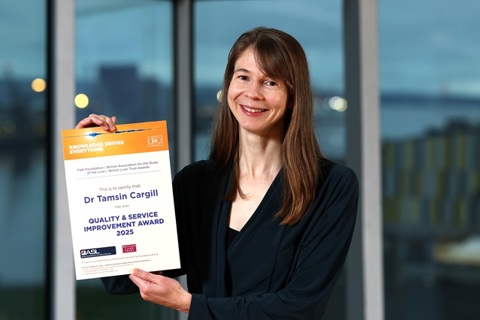
Dr Tamsin Cargill received the 2025 Quality and Service Improvement in Hepatology Award for the service. Photograph by Declan Roughan / Press Eye.
Liver disease is a growing and urgent challenge for the NHS. Unplanned admissions have risen sharply in the past decade (more than 50%), and around 35% of patients die within 60 days of discharge. Many patients experience frequent, unpredictable complications.
But traditional hospital-based care can be burdensome for older, frail patients who would prefer to remain at home, and existing evidence and policy reviews suggest a need for new, community-based models that combine specialist expertise with flexible care delivery.
In response to these trends and pressures, Dr Tamsin Cargill – an NIHR-funded Academic Clinical Lecturer at the University of Oxford and a hepatology registrar at Oxford University Hospitals NHS Foundation Trust – developed Hepatology at Home, the UK’s first service to bring hospital-level diagnosis and treatment into people’s homes.
A community-based model of liver care
Oxfordshire benefits from a well-established Hospital at Home service that provides support and care such as clinical assessment, blood tests, ultrasound scans and intravenous treatment in patients’ homes. The Hepatology at Home initiative developed organically within this context, through Dr Cargill’s routine clinical practice at the John Radcliffe Hospital.
“I was referring general medical patients to Hospital at Home where it was difficult for them to travel back to the outpatient or ambulatory unit each day,” says Dr Cargill. “At the same time, I was seeing hepatology patients – often younger but just as frail – who required ambulatory care but struggled with repeated hospital attendance. So, I started referring a few of those patients to the Hospital at Home team and providing specific advice on hepatology.”
This informal arrangement grew into Hepatology at Home following a proposal involving both the Oxford Liver Unit and Hospital at Home. Working together, representatives of both teams produced standard operating procedures for the referral and patient management processes. Under the model, the Hospital at Home team conducts most home visits, receiving hepatology input via regular multidisciplinary meetings alongside ad hoc discussions. Escalation routes are in place for patients requiring hospital admission or specialist procedures.
“It’s the first service in the UK that carries out this kind of hepatology work in the home,” says Dr Cargill.
Delivering impact at home
Over its first 12 months from April 2024, the Hepatology at Home service saw 40 patients across 67 discrete episodes of care. The cohort reflected the clinical reality of advanced liver disease: a median age of 67, and the majority of patients living with cirrhosis related to metabolic or alcohol-associated risk factors. Most referrals were for the management of common complications, such as fluid build-up, that are known to drive repeated hospital attendance and readmission.
The primary outcome measure – the number of days patients were able to remain at home while receiving specialist assessment and treatment – demonstrated a clear impact. Across the evaluation period, the service was associated with 269 additional days spent at home. Of these, 156 replaced inpatient hospital bed days and 113 replaced hospital-based ambulatory hepatology assessments, with no unexpected deaths. In practical terms, this represents both a release of acute hospital capacity and a shift in the location of safe, specialist liver care.
“It allows care to be completely patient-centred,” says Dr Cargill. “The patients we refer to the service want to be treated at home, and while readmission and mortality often aren’t preventable in advanced liver disease, we enable people to spend less time in hospital.”
Feedback has been overwhelmingly positive: patients report feeling more comfortable and value spending time at home with their families instead of travelling to hospital and waiting on wards. The initiative has even won a national award for quality and service improvement in hepatology.
The power of partnership
Hepatology at Home is built on close collaboration between different clinical services within the NHS, and with academia. “Collaboration between academia and healthcare has been key to the success of the project,” says Dr Cargill. “Without my 50% university time to think about Hepatology at Home at a research level, it would have stayed purely as a local intervention. Instead, we were able to ask: ‘What is this service doing? How can we measure and evaluate it? How might it be implemented in other settings across the UK and internationally?’”
Dr Cargill has established a UK hepatology ambulatory network, bringing together clinicians and allied health professionals from across the country to share knowledge and act as a research platform. The project has also opened up new collaborations internationally, including with researchers in Melbourne working on similar models of care.
“Setting up and sustaining a service like this has a lot of challenges,” adds Dr Cargill. “We’re looking at different ways of funding the service, as well as seeking funding to carry out further academic research. But what the pilot project has shown is that it can be done. It’s a privilege to offer patients real choice about where they receive care, and the success is a testament to the vision and forward thinking of everyone involved.”
In 2025, Dr Cargill received the 2025 Quality and Service Improvement in Hepatology Award at the Dr Falk UK/BASL/BLT Awards for the project Hepatology at Home: a novel pathway for the integrated management of patients with liver disease in the home.